Provider review
A licensed provider reads your health history, decides if a B12 injection is right for you and sets the schedule.
Compounded medicine, by prescription
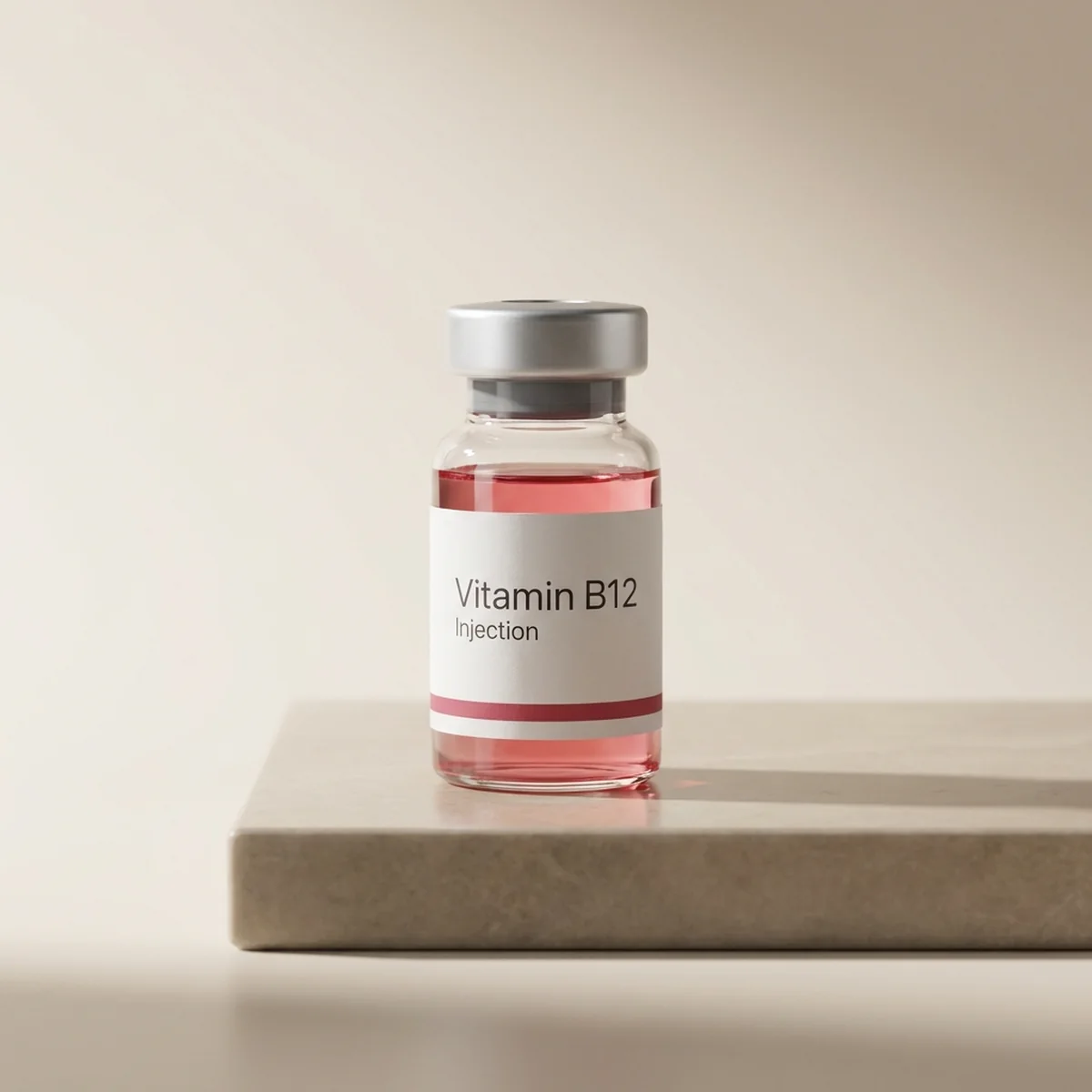
A compounded vitamin B12 (cyanocobalamin) injection after a licensed provider's review. Not FDA approved. A licensed 503A compounding pharmacy prepares your order and ships it free.
From $121/mo with the 12-month plan and auto-refill
How would you like to pay?
Choose your plan
Prescription treatment requires an online medical evaluation. A provider decides whether treatment is appropriate; approval is not guaranteed.
Your plan
A licensed provider reads your health history, decides if a B12 injection is right for you and sets the schedule.
A compounded cyanocobalamin injection, a monthly vial, prepared by a licensed compounding pharmacy after approval.
Delivered to your door at no added cost.
Pay once, or turn on auto-refill and take 10% off. Change or cancel refills anytime.
A printable decision pack and a plain checklist for reading a study.
Help with your order and delivery when you need it.
How it works
Pick 1, 3, 6 or 12 months. Auto-refill takes 10% off each plan.
Answer a private online questionnaire. A licensed provider reviews it and sets the schedule.
If prescribed, the pharmacy prepares your order and ships it to you free.
FAQ
The things people ask most before starting Vitamin B12 injection.
A compounded vitamin B12 (cyanocobalamin) injection, a monthly vial, after a licensed provider's review. Your provider sets the schedule. A licensed 503A compounding pharmacy prepares your order and ships it free.
Vitamin B12 injection paid once: $169 for 1 month, $456 for 3 months, $862 for 6 months or $1,622 for 12 months. With auto-refill each is 10% off: $152, $410, $775 and $1,459 ($121.58 a month on the 12-month plan). Shipping is free, and the exact total is shown before you pay.
Yes. You complete an online health intake and a licensed provider decides whether a B12 injection is right for you and sets the schedule. Choosing a plan does not guarantee a prescription.
Cyanocobalamin injection, USP is a prescription product: the Drugs@FDA record for ANDA 080515 lists cyanocobalamin 1MG/ML injection with marketing status Prescription. The injection sold here is compounded, and FDA states that compounded drugs are not FDA-approved, which means FDA does not verify the safety, effectiveness or quality of compounded drugs before they are marketed.
The cyanocobalamin injection label states it is indicated for vitamin B12 deficiencies due to malabsorption which may be associated with Addisonian (pernicious) anemia, gastrointestinal pathology, dysfunction, or surgery, fish tapeworm infestation, malignancy of pancreas or bowel, and folic acid deficiency. It also states that requirements of vitamin B12 in excess of normal can usually be met with oral supplementation, and that a vegetarian diet which contains no animal products does not supply any vitamin B12 and that patients following such a diet should be advised to take oral vitamin B12 regularly.
The sources do not show that. A systematic review and meta-analysis states that vitamin B12 is often used to improve cognitive function, depressive symptoms, and fatigue, that in most cases such complaints are not associated with overt vitamin B12 deficiency, and that the effectiveness of supplementation in such cases is uncertain. A randomized placebo-controlled trial in IBS and IBD patients with deactivating fatigue and normal B12 levels did not confirm the expected effect on fatigue, a trial of cyanocobalamin injection against placebo found no significant difference in physical performance capacity, and a placebo-controlled study of B12 injections in people with biochemical signs of deficiency reported that treatment influenced only one of eight dimensions of health-related quality of life.
A review in American Family Physician lists gastric or small intestine resections, inflammatory bowel disease, use of metformin for more than four months, use of proton pump inhibitors or histamine H2 blockers for more than 12 months, vegans or strict vegetarians, and adults older than 75 years as examples of risk factors, and states that screening average-risk adults for deficiency is not recommended. MedlinePlus says an MMA test is most often used to diagnose a vitamin B12 deficiency, and a guideline states that definitive cut-off points to define deficiency states are not possible.
In a Cochrane review of 3 trials, low quality evidence showed oral and intramuscular vitamin B12 having similar effects in terms of normalising serum vitamin B12 levels, and no trial reported on clinical signs and symptoms. A review in American Family Physician states that oral high-dose vitamin B12 (1 to 2 mg daily) is as effective as intramuscular administration for correcting anemia and neurologic symptoms, and that intramuscular therapy leads to more rapid improvement and should be considered in patients with severe deficiency or severe neurologic symptoms. The label states that oral absorption is considered too undependable to rely on in patients with pernicious anemia or other conditions resulting in malabsorption of vitamin B12.
The label lists sensitivity to cobalt and/or vitamin B12 as a contraindication and warns that anaphylactic shock and death have been reported after parenteral vitamin B12 administration, that hypokalemia and sudden death may occur in severe megaloblastic anemia which is treated intensely, that patients with early Leber's disease (hereditary optic nerve atrophy) who were treated with cyanocobalamin suffered severe and swift optic atrophy, and that patients should be warned about the danger of taking folic acid in place of vitamin B12.
The label lists pulmonary edema and congestive heart failure early in treatment and peripheral vascular thrombosis in the cardiovascular category, and polycythemia vera, mild transient diarrhea, itching, transitory exanthema and a feeling of swelling of entire body. The label also lists, in a generalized category, that anaphylactic shock and death have been reported with administration of parenteral vitamin B12. A MedlinePlus health topic page on anaphylaxis states that anaphylaxis is a serious allergic reaction and that if someone is having a serious allergic reaction, call 911.
A population-based observational cohort study concluded that high cobalamin levels were associated with the risk of subsequently diagnosed cancer, mostly within the first year of follow-up, and a systematic review concluded the evidence suggests an association between elevated B12 and a higher risk of cancer. A scoping review of human studies concluded there is not sufficient evidence to assume that high plasma vitamin B12, high B12 intake, or treatment with pharmacological doses of vitamin B12, is causally related to cancer. Observational studies cannot show cause and effect.
The label states that adequate and well-controlled studies have not been done in pregnant women and that vitamin B12 is an essential vitamin and requirements are increased during pregnancy, that vitamin B12 is known to be excreted in human milk, and that the recommended amounts (4 mcg daily) should be consumed during pregnancy and lactation. The label also states that the need for vitamin B12 is increased by pregnancy and lactation. The NHLBI states that your healthcare provider can look at your medical history to help determine how much vitamin B12 you need each day.
FDA states that section 503A describes the conditions under which compounded human drug products are exempt from the FD&C Act sections on FDA approval prior to marketing, current good manufacturing practice (CGMP) requirements, and labeling with adequate directions for use. FDA also states that compounded drugs should only be used in patients whose medical needs cannot be met by an FDA-approved drug, and that poor compounding practices can result in serious drug quality problems, such as contamination or a drug that contains too much or too little active ingredient.
No. You can pay once for 1, 3, 6 or 12 months, or turn on auto-refill and take 10% off. You can change or cancel refills anytime.